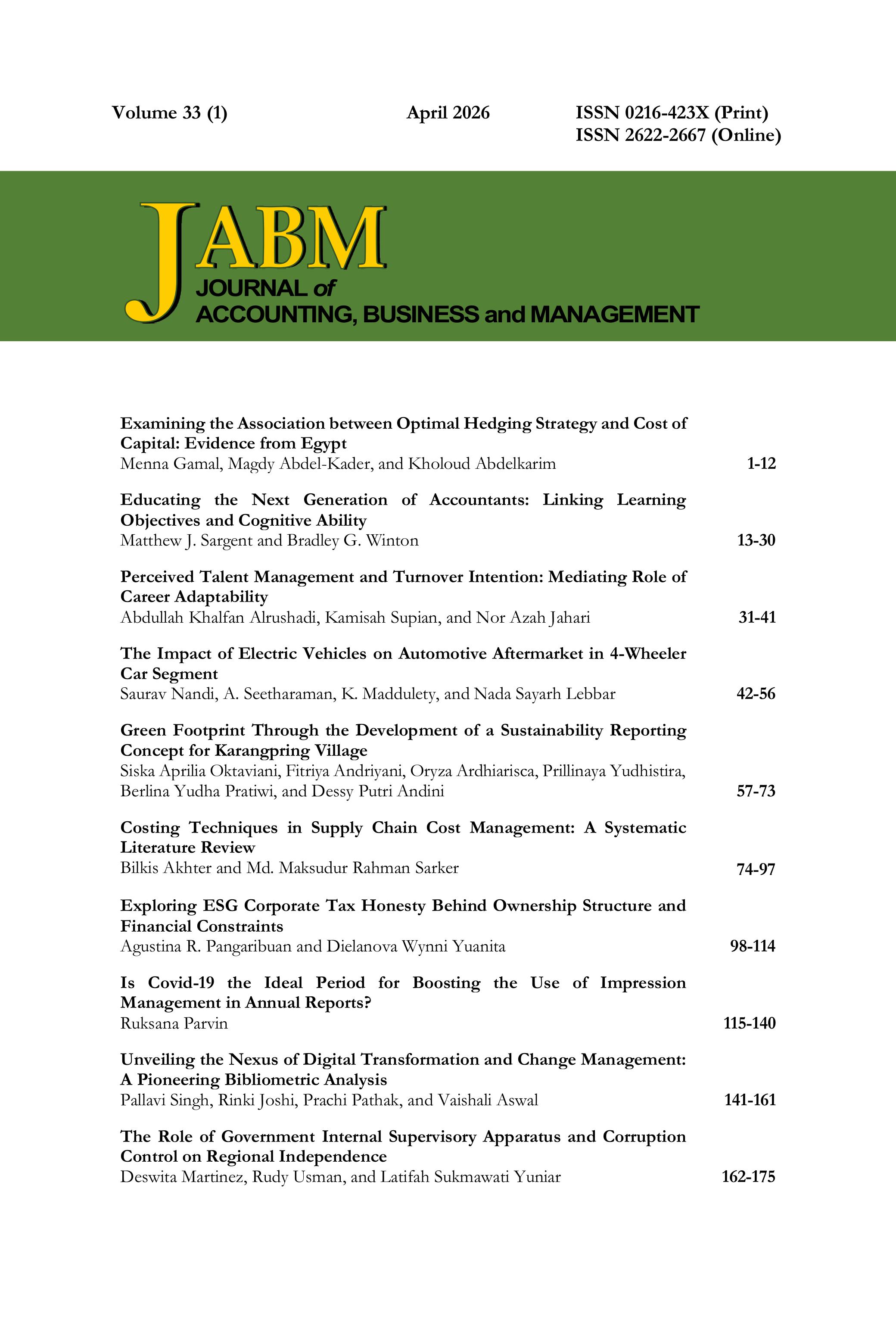
Unveiling the Nexus of Digital Transformation and Change Management: A Pioneering Bibliometric Analysis
Abstract
As the digital market grows, businesses must embrace digital transformation (DT) to remain competitive. The integration of digital technologies has redefined business operations, models, and customer engagement. However, successful DT is not solely a technological initiative—it requires robust change management (CM) to address resistance, enhance organisational agility, and ensure long-term sustainability. This study presents the first bibliometric analysis to explore the intersection of DT and CM, offering a comprehensive view of how scholarship in these domains has evolved. Using VOSviewer and Biblioshiny, we conduct co-citation and co-occurrence mapping to identify influential studies, emerging trends, and persistent research gaps. Scopus was chosen as the primary database for material processing, given its extensive coverage of peer-reviewed literature across disciplines. In addition, data sources such as surveys, databases, and digital archives were integrated to provide valuable insights and contextual depth, ensuring a more nuanced and holistic analysis. The findings highlight the growing importance of DT and underscore the critical role of leadership, skill development, and effective technology implementation in driving change. Our study reveals that research in this area increasingly emphasizes the integration of technology with management practices and employee engagement. By combining bibliometric analysis with diverse data sources, this article not only maps the trajectory of DT and CM research but also identifies opportunities for future investigation. Ultimately, the study calls for a comprehensive approach that blends technological innovation, managerial processes, and workforce adaptability to help organisations thrive in an era of rapid digital change.
Downloads
References
Ahmad, T. (2022). Leading digital transformation: The role of leadership styles and change management practices. Journal of Open Innovation: Technology, Market, & Complexity, 8(3), 129.
Ajzen, I. (1991). The theory of planned behavior. Organizational Behavior & Human Decision Processes, 50(2), 179-211. [https://doi.org/10.1016/0749-5978(91)90020-T](https://doi.org/10.1016/0749-5978\(91\)90020-T).
Al-Moaid, N. A. A., & Almarhdi, S. G. (2024). Developing dynamic capabilities for successful digital transformation projects: The mediating role of change management. Journal of Innovation & Entrepreneurship, 13(1), 1-26. [https://doi.org/10.1186/s13731-024-00446-9](https://doi.org/10.1186/s13731-024-00446-9).
Anyieni, A., Ondari, C. G., Mayianda, R., & Damaris, K. A. (2016). Organizational change: A critical review of the literature. The International Journal of Professional Management, 11(2), 1-6. [https://ir-library.ku.ac.ke/server/api/core/bitstreams/a593c274-0c5d-4673-84a5-162dfe330073/content](https://ir-library.ku.ac.ke/server/api/core/bitstreams/a593c274-0c5d-4673-84a5-162dfe330073/content).
Appelbaum, S. H., Habashy, S., Malo, J. -L., & Shafiq, H. (2012). Back to the future: Revisiting Kotter’s 1996 change model. Journal of Management Development, 31(8), 764-782. [http://dx.doi.org/10.1108/02621711211253231](http://dx.doi.org/10.1108/02621711211253231).
Bąk, D., & Bąk, S. (2024). Change management in healthcare – a scoping literature review. E-Mentor, 104(2), 23-33. [https://doi.org/10.15219/em104.1652](https://doi.org/10.15219/em104.1652).
Barney, J. B. (1991). Firm resources and sustained competitive advantage. Journal of Management, 17(1), 99-120. [https://doi.org/10.1177/014920639101700108](https://doi.org/10.1177/014920639101700108).
Barthel, P., & Hess, T. (2020). Towards a characterization of digitalization projects in the context of organizational transformation. Pacific Asia Journal of the Association for Information Systems, 12(3), 31-56. [https://doi.org/10.17705/1pais.12302](https://doi.org/10.17705/1pais.12302).
Bass, B. M., & Riggio, R. E. (2006). Transformational leadership (2nd ed.). New York: Psychology Press. [https://doi.org/10.4324/9781410617095](https://doi.org/10.4324/9781410617095).
Beer, M., & Nohria, N. (2009). Cracking the code of change. In The principles and practice of change (pp. 63–73). UK: Palgrave Macmillan. [https://doi.org/10.1007/978-1-137-16511-4\_4](https://www.google.com/search?q=https://doi.org/10.1007/978-1-137-16511-4_4).
Bridges, W. (2009). Managing transitions: Making the most of change (3rd ed.). Da Capo Press.
Brunetti, F., Matt, D. T., Bonfanti, A., De Longhi, A., Pedrini, G., & Orzes, G. (2020). Digital transformation challenges: Strategies emerging from a multi-stakeholder approach. The TQM Journal, 32(4), 697-724. [https://doi.org/10.1108/TQM-12-2019-0309](https://doi.org/10.1108/TQM-12-2019-0309).
Chang, M., Jang, H. -B., Li, Y.-M., & Kim, D. (2017). The relationship between the efficiency, service quality and customer satisfaction for state-owned commercial banks in China. Sustainability, 9(12), 2163. [https://doi.org/10.3390/su9122163](https://doi.org/10.3390/su9122163).
Chatterjee, S., Rana, N. P., Dwivedi, Y. K., & Baabdullah, A. M. (2021). Understanding AI adoption in manufacturing and production firms using an integrated TAMTOE model. Technological Forecasting and Social Change, 170, 120880. [https://doi.org/10.1016/j.techfore.2021.120880](https://doi.org/10.1016/j.techfore.2021.120880).
Chen, J., Xu, Y., & Zhang, L. (2024). Adoption of artificial intelligence driven decision systems: Organizational challenges and strategic approaches. Journal of Business Research, 174, 114512.
Chiu, H. (2021). The effect of manager attitude and team attitude on employee commitment to change: The moderating roles of power distance orientation and gender composition. International Journal of Innovation Management, 25(8), 2150088. [https://doi.org/10.1142/S1363919621500882](https://doi.org/10.1142/S1363919621500882)
Coviello, N., Kano, L., & Liesch, P. W. (2017). Adapting the uppsala model to a modern world: Macro-context and microfoundations. Journal of International Business Studies, 48(9), 1151-1164. [https://doi.org/10.1057/s41267-017-0120-x](https://doi.org/10.1057/s41267-017-0120-x).
Creasey, T. (2007). Defining change management. Prosci & the Change Management Learning Center, 1-6. [http://www.change-management.com/prosci-defining-cjangemanagement.pdf](http://www.change-management.com/prosci-defining-cjangemanagement.pdf).
Dabbous, A., Barakat, K. A., & Kraus, S. (2023). The impact of digitalization on entrepreneurial activity and sustainable competitiveness: A panel data analysis. Technology in Society, 73, 102224. [https://doi.org/10.1016/j.techsoc.2023.102224](https://doi.org/10.1016/j.techsoc.2023.102224).
Donthu, N., Kumar, S., Pandey, N., Pandey, N., & Mishra, A. (2021). Mapping the electronic word-of-mouth (eWOM) research: A systematic review and bibliometric analysis. Journal of Business Research, 135, 758-773. [https://doi.org/10.1016/j.jbusres.2021.07.015](https://doi.org/10.1016/j.jbusres.2021.07.015).
George, B., & Wooden, O. (2023). Managing the strategic transformation of higher education through artificial intelligence. Administrative Sciences, 13(9), 196
Ghobakhloo, M., & Iranmanesh, M. (2021). Digital transformation success under Industry 4.0: A strategic guideline for manufacturing SMEs. Journal of Manufacturing Technology Management, 32(8), 1533-1556. [https://doi.org/10.1108/JMTM-11-2020-0455](https://doi.org/10.1108/JMTM-11-2020-0455)
Gong, S. (2023). Digital transformation of supply chain management in retail and ecommerce. International Journal of Retail & Distribution Management, 53(2), 1-19. [https://doi.org/10.1108/IJRDM-02-2023-0076](https://doi.org/10.1108/IJRDM-02-2023-0076).
Guenzi, P., & Nijssen, E. J. (2021). The impact of digital transformation on salespeople: An empirical investigation using the JD-R model. Journal of Personal Selling & Sales Management, 41(2), 130.149. [https://doi.org/10.1080/08853134.2021.1918005](https://doi.org/10.1080/08853134.2021.1918005).
Hess, T., Benlian, A., Matt, C., & Wiesbrock, F. (2016). Options for formulating a digital transformation strategy. MIS Quarterly Executive, 15(2), 123-139. [https://www.scopus.com/pages/publications/85011959099](https://www.scopus.com/pages/publications/85011959099).
Hiatt, J. (2006). ADKAR: A model for change in business, government, and our community (1st ed.). Loveland, Colorado: Prosci Learning Center Publications.
Hussain, M., & Papastathopoulos, A. (2022). Organizational readiness for digital financial innovation and financial resilience. International Journal of Production Economics, 243, 108326. [https://doi.org/10.1016/J.IJPE.2021.108326](https://doi.org/10.1016/J.IJPE.2021.108326).
Hwang, B. -G., Ngo, J., & Teo, J. Z. K. (2022). Challenges and strategies for the adoption of smart technologies in the construction industry: The case of Singapore. Journal of Management in Engineering, 38(1), 05021014. [https://doi.org/10.1061/(ASCE)ME.1943-5479.0000986](https://www.google.com/search?q=https://doi.org/10.1061/\(ASCE\)ME.1943-5479.0000986).
Jackson, N. C. (2019). Managing for competency with innovation change in higher education: Examining the pitfalls and pivots of digital transformation. Business Horizons, 62(6), 761-772. [https://doi.org/10.1016/j.bushor.2019.08.002](https://doi.org/10.1016/j.bushor.2019.08.002).
Kadir, B. A., & Broberg, O. (2020). Human well-being and system performance in the transition to industry 4.0. International Journal of Industrial Ergonomics, 76, 102936. [https://doi.org/10.1016/j.ergon.2020.102936](https://doi.org/10.1016/j.ergon.2020.102936).
Khaw, K. W., Alnoor, A., Al-Barrow, H., Tiberius, V., Ganesan, Y., & Atshan, N. A. (2022). Reactions towards organizational change: A systematic literature review. Current Psychology, 42(22), 19137–19160. [https://doi.org/10.1007/s12144-022-03070-6](https://doi.org/10.1007/s12144-022-03070-6).
Kohtamäki, M., Parida, V., Oghazi, P., Gebauer, H., & Baines, T. (2019). Digital servitization business models in ecosystems: A theory of the firm. Journal of Business Research, 104, 380-392. [https://doi.org/10.1016/j.jbusres.2019.06.027](https://doi.org/10.1016/j.jbusres.2019.06.027).
Kohtamäki, M., Rabetino, R., Einola, S., Parida, V., & Patel, P. (2021). Unfolding the digital servitization path from products to product-service-software systems: Practicing change through intentional narratives. Journal of Business Research, 137, 379-392. [https://doi.org/10.1016/j.jbusres.2021.08.027](https://doi.org/10.1016/j.jbusres.2021.08.027).
Kotarba, M. (2018). Digital transformation of business models, Foundations of Management, 10(1), 123-142. [https://doi.org/10.2478/fman-2018-0011](https://doi.org/10.2478/fman-2018-0011).
Kotter, J. P. (2006). Leading change: Why transformation efforts fail. Harvard Business Review Press. www.hbr.org.
Kraus, S., Jones, P., Kailer, N., Weinmann, A., Chaparro-Banegas, N., & Roig-Tierno, N. (2021). Digital transformation: An overview of the current state of the art of research. Sage Open, 11(3). 1-15. [https://doi.org/10.1177/21582440211047576](https://doi.org/10.1177/21582440211047576).
Lederer, M., & Riedl, R. (2020). The impact of digitization on knowledge-intensive services and processes. SMR - Journal of Service Management Research, 4(2-3), 105-118.
Lewin, K. (1947). Frontiers in group dynamics: Concept, method and reality in social science; social equilibria and social change. Human Relations, 1(1), 5-41. [https://doi.org/10.1177/001872674700100103](https://doi.org/10.1177/001872674700100103).
Looy, A. V. (2021). A quantitative and qualitative study of the link between business process management and digital innovation. Information & Management, 58(2), 103413. [https://doi.org/10.1016/j.im.2020.103413](https://doi.org/10.1016/j.im.2020.103413).
Magistretti, S., Pham, C. T. A., & Dell’Era, C. (2021). Enlightening the dynamic capabilities of design thinking in fostering digital transformation. Industrial Marketing Management, 97, 59-70. [https://doi.org/10.1016/j.indmarman.2021.06.014](https://www.google.com/search?q=https://doi.org/10.1016/j.indmarman.2021.06.014).
Maijanen, P. (2020). Managing digital transformation: The case of the finnish broadcasting company. In Media Management Matters (1st ed., pp. 204-217). Routledge. [https://doi.org/10.4324/9780429265396-13](https://doi.org/10.4324/9780429265396-13).
Matt, C., Hess, T., & Benlian, A. (2015). Digital transformation strategies. Business & Information Systems Engineering, 57(5), 339-343. Doi: 10.1007/s12599-015-0401-5.
Montreuil, V. -L. (2020). Organization change: Theory and practice (5th ed.), by Warner. W. Burke. (2018). Relations Industrielles/Industrial Relations, 75(2), 406-408. [https://doi.org/10.7202/1070356ar](https://doi.org/10.7202/1070356ar).
Mugge, P., Abbu, H., Michaelis, T., Kwiatkowski, A., & Gudergan, G. (2020). Patterns of digitization: A practical guide to digital transformation. Research-Technology Management, 63(2), 27-35. [https://doi.org/10.1080/08956308.2020.1707003](https://doi.org/10.1080/08956308.2020.1707003).
Nakayama, R., Suzuki, R., Nakamaru, S., Niiyama, R., Kawahara, Y., & Kakehi, Y. (2019). MorphIO: MorphIO: Entirely soft sensing and actuation modules for programming shape changes through tangible interaction (pp. 975-986). DIS ’19: Proceedings of the 2019 on Designing Interactive Systems Conference. [https://doi.org/10.1145/3322276.3322337](https://doi.org/10.1145/3322276.3322337).
Oh, K., Kho, H., Choi, Y., & Lee, S. (2022). Determinants for successful digital transformation. Sustainability, 14(3), 1215. [https://doi.org/10.3390/su14031215](https://doi.org/10.3390/su14031215)
Papadonikolaki, E. (2018). Loosely coupled systems of innovation: Aligning BIM adoption with implementation in Dutch construction. Journal of Management in Engineering, 34(6), 1-13. [https://doi.org/10.1061/(ASCE)ME.1943-5479.0000644](https://doi.org/10.1061/\(ASCE\)ME.1943-5479.0000644)
Parviainen, P., Tihinen, M., Käärläinen, J., & Teppola, S. (2022). Tackling the digitalization challenge: How to benefit from digitalization in practice. International Journal of Information Systems & Project Management, 5(1), 63-77. [https://doi.org/10.12821/ijispm050104](https://doi.org/10.12821/ijispm050104).
Paul, J., Ueno, A., Dennis, C., Alamanos, E., Curtis, L., Foroudi, P., Kacprzak, A., Kunz, W. H., Liu, J., Marvi, R., Nair, S. L. S., Ozdemir, O., Pantano, E., Papadopoulos, T., Petit, O., Tyagi, S., & Wirtz, J. (2024). Digital transformation: A multidisciplinary perspective and future research agenda. International Journal of Consumer Studies, 48(2). [https://doi.org/10.1111/ijcs.13015](https://doi.org/10.1111/ijcs.13015).
Pihir, I., Tomičić-Pupek, K., & Furjan, M. T. & (2019). Digital transformation playground – literature review and framework of concepts. Journal of Information & Organizational Sciences, 43(1), 33-48. [https://doi.org/10.31341/jios.43.1.3](https://doi.org/10.31341/jios.43.1.3).
Raj, A., Dwivedi, G., Sharma, A., Lopes de Sousa Jabbour, A. B., & Rajak, S. (2020). Barriers to the adoption of industry 4.0 technologies in the manufacturing sector: An inter-country comparative perspective. International Journal of Production Economics, 224, 107546. [https://doi.org/10.1016/j.ijpe.2019.107546](https://doi.org/10.1016/j.ijpe.2019.107546).
Ramesh, N., & Delen, D. (2021). Digital transformation: How to beat the 90% failure rate? IEEE Engineering Management Review, 49(3), 22-25. [https://doi.org/10.1109/EMR.2021.3070139](https://doi.org/10.1109/EMR.2021.3070139).
Reineholm, C., Lundqvist, D., & Wallo, A. (2024). Change competence: An integrative literature review. Work, 79(2), 569-584. [https://doi.org/10.3233/WOR-230633](https://doi.org/10.3233/WOR-230633).
Rodríguez-Espíndola, O., Chowdhury, S., Dey, P. K., Albores, P., & Emrouznejad, A. (2022). Analysis of the adoption of emergent technologies for risk management in the era of digital manufacturing. Technological Forecasting & Social Change, 178, 121562. [https://doi.org/10.1016/j.techfore.2022.121562](https://doi.org/10.1016/j.techfore.2022.121562).
Sarkis, J., Kouhizadeh, M., & Zhu, Q. S. (2020). Digitalization and the greening of supply chains. Industrial Management & Data Systems, 121(1), 65-85. [https://doi.org/10.1108/IMDS-08-2020-0450](https://doi.org/10.1108/IMDS-08-2020-0450).
Schein, E. H. (2010). Organizational culture and leadership (vol. 2). John Wiley & Sons.
Singh, S., Akbani, I., & Dhir, S. (2020). Service innovation implementation: A systematic review and research agenda. The Service Industries Journal, 40(7–8), 491-517. [https://doi.org/10.1080/02642069.2020.1731477](https://doi.org/10.1080/02642069.2020.1731477).
Solberg, E., Traavik, L. E. M., & Wong, S. I. (2020). Digital mindsets: Recognizing and leveraging individual beliefs for digital transformation. California Management Review, 62(4), 105-124. [https://doi.org/10.1177/0008125620931839](https://doi.org/10.1177/0008125620931839).
Soluk, J., Miroshnychenko, I., Kammerlander, N., & De Massis, A. (2021). Family influence and digital business model innovation: The enabling role of dynamic capabilities. Entrepreneurship Theory & Practice, 45(4), 867-905. [https://doi.org/10.1177/1042258721998946](https://doi.org/10.1177/1042258721998946).
Stoumpos, A. I., Kitsios, F., & Talias, M. A. (2023). Digital transformation in healthcare: Technology acceptance and its applications. International Journal of Environmental Research & Public Health, 20(4), 3407. [https://doi.org/10.3390/ijerph20043407](https://doi.org/10.3390/ijerph20043407).
Tay, S. I., Alipal, J., & Lee, T. C. (2021). Industry 4.0: Current practice and challenges in Malaysian manufacturing firms. Technology in Society, 67, 101749. [https://doi.org/10.1016/J.TECHSOC.2021.101749](https://doi.org/10.1016/J.TECHSOC.2021.101749).
Teece, D. J., Pisano, G., & Shuen, A. (1997). Dynamic capabilities and strategic management. Strategic Management Journal, 18(7), 509-533. Doi: 10.1142/9789812834478\_0002.
Troise, C., Corvello, V., Ghobadian, A., & O’Regan, N. (2022). How can SMEs successfully navigate the VUCA environment: The role of agility in the digital transformation era. Technological Forecasting & Social Change, 174, 121227. Doi: 10.1016/j.techfore.2021.121227.
Trzaska, R., Sulich, A., Organa, M., Niemczyk, J., & Jasiński, B. (2021). Digitalization business strategies in energy sector: Solving problems with uncertainty under industry 4.0 conditions. Energies, 14(23), 7997. [https://doi.org/10.3390/en14237997](https://doi.org/10.3390/en14237997).
Van Veldhoven, Z., & Vanthienen, J. (2023). Best practices for digital transformation based on a systematic literature review. Digital Transformation & Society, 2(2), 104-128. Doi: 10.1108/DTS-11-2022-0057.
Varshney, D. (2020). Digital transformation and creation of an agile workforce: Exploring company initiatives and employee attitudes. In M. A. Turkmenoglu, & B. Cicek (Ed.), Contemporary Global Issues in Human Resource Management (pp. 89-105). Emerald Publishing Limited. [https://doi.org/10.1108/978-1-80043-392-220201009](https://doi.org/10.1108/978-1-80043-392-220201009).
Vrcelj, N. (2023). Towards successful organizational change management: New process model identification. Journal of Process Management & New Technologies, 11(3-4), 1-15. [https://doi.org/10.5937/jpmnt11-45953](https://doi.org/10.5937/jpmnt11-45953)
Zangana, H. M., Bazeed, S. M. S., Ali, N. Y., & Abdullah, D. T. (2024). Navigating project change: A comprehensive review of change management strategies and practices. Indonesian Journal of Education & Social Sciences, 3(2), 166-179. [https://doi.org/10.56916/ijess.v3i2.735](https://doi.org/10.56916/ijess.v3i2.735).
Zhu, X., & Zhang, H. (2024). Research on organizational change of enterprises under the background of digital transformation. Academic Journal of Business & Management, 6(9), 162–167. [https://doi.org/10.25236/AJBM.2024.060923](https://doi.org/10.25236/AJBM.2024.060923).
Zupic, I., & Čater, T. (n.d.). Bibliometric methods in management and organization. [http://ssrn.com/abstract=2267251](http://ssrn.com/abstract=2267251)